


Patient Engagement
Reflections from the Patient-Centricity & Collaboration World Congress Europe
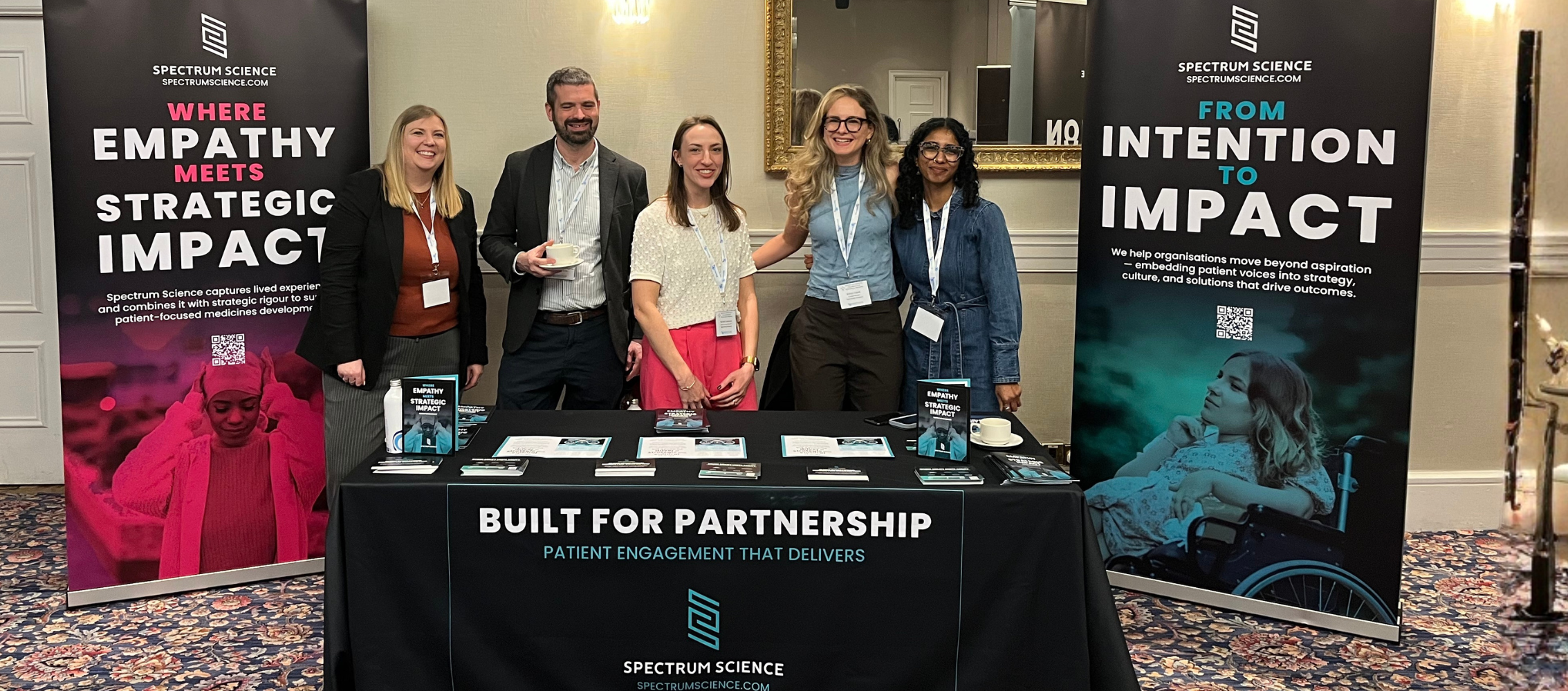
It was an inspiring few days at the Patient-Centricity & Collaboration World Congress Europe, which we at Spectrum Science sponsored for the first time.
The ambition to make patient-centricity the default mindset in healthcare remains incredibly strong, and there were plenty of examples of real progress. This is largely a congress of committed advocates, and the passion in the room was unmistakable. At the same time, changing corporate structures, shifting views on the role of patient advocacy, and broader political and economic headwinds are creating a very turbulent environment. And despite all the public rhetoric, skepticism still lingers among more empirically minded stakeholders about the true value of patient engagement.
Even so, the signs ahead are positive. Regulators are increasingly backing patient-focused medicines development, and the recent World Health Assembly resolution on social participation offers an evidence-based roadmap for embedding patients in health design and decision-making. So, while the rain and wind beat us at this turn in the trail, the sun is clearly shining on the path ahead. Staying the course will take resilience, rooted in purpose, and progress will depend on how convincingly we create and communicate value.
Four key takeaways from the 2026 meeting:
- Caregiver rising: Caregivers often sit in the shadow of patients, despite carrying a heavy emotional, financial and practical load. Surveys show that many skip or delay their own medical appointments because they are too busy looking after someone else. The tide is turning though, with companies like BMS and Kyowa Kirin now elevating the importance of caregivers in the healthcare equation.
- Boiling down measurement: Measuring the impact of patient engagement remains notoriously tricky. Outcomes are often long term, much of the value is captured qualitatively, and different stakeholders see patient engagement-derived value differently. Tools like the PFMD metrics selector, with more than 100 metrics, are comprehensive but can overwhelm. At the congress, a clear point of convergence emerged: track how patient insights actually influence strategy and decision-making across the organisation.
- Tapestry without texture: People most affected by health disparities often do not engage with the system because they do not feel part of its fabric. One sickle cell cancer patient advocate described healthcare as a tapestry that must be woven with many strands to reflect the diversity of society. It was also noted that different levels of fear and acceptance strongly shape health decisions, yet these dynamics are frequently overlooked when organisations design engagement with the public and patients.
- More than you can imagine: This year’s Rare Disease Day theme captures the resilience and determination of rare disease advocates who repeatedly go beyond what most of us would consider possible. One father and advocate described selling their family home to move to the US so their child with Duchenne Muscular Dystrophy could join a potentially life-saving trial, only for the trial to be discontinued at the last moment. This father now runs his own rare disease organisation so that other families may not have to do “more than you can imagine” to access care. You can support Rare Disease Day 2026 here.
Spectrum Science patient engagement is where empathy meets strategic impact. Contact us today to learn more.
Perspectives
Patient Engagement
A New Way of Thinking About Patient Activation

Patient Engagement
Turning Experience into Value: Europe’s Opportunity to Lead on Patient-Focused Medicines Development
Patient Engagement
Solving the patient engagement value equation

Medical Communications ,
Patient Engagement
Spectrum Science Communications awarded PIF TICK accreditation to become a ‘trusted information creator’