




At its core, participation in a clinical trial is not a transaction; it’s personal. And at Spectrum Science Clinical, formerly Continuum Clinical, it’s the way we’ve always approached our work in this field. For patients and caregivers, their involvement in driving momentum of trials forward is dependent on trust, understanding, and the perceived value of what they are getting into. Our empathetic approach to this work is rooted in the personal stories that span across the Spectrum Science platform.
What This Looks Like in Real Life
For Natalia Boyle, Learning & Development Specialist, a clinical trial became a turning point for her family. When her mother’s treatment options narrowed, she enrolled in a Phase 2 study targeting the specific gene mutation driving her cancer. Natalia describes the shift as both scientific and emotional: “Her care team was attentive and genuinely invested in her,” she says, and for the first time in a while, they felt like they were no longer “running out of road.” Unfortunately, her mother ultimately passed away, but the additional time the trial made possible reshaped how Natalia sees this industry—and why contributing to it matters.
For Amanda Changuris, SVP, Social Media, participation meant contributing before a diagnosis ever existed. With a strong family history of colon cancer, she enrolled in a longitudinal prevention study designed to track lifestyle and behaviors over time. As Amanda explains, “I joined the study because of my strong family history of colon cancer. My grandparents on my father’s side both passed away from it. My grandmother on my mother’s side beat it. And then my father had it in his 60s and beat it.” That belief in progress through participation is part of why she’s proud to work at Spectrum: the work is personal, and advancing research depends on people choosing to show up.
And for Heather Jackson, Director, Client Services, the decision to participate extended beyond human health. When her dog, Ruby, was diagnosed with an aggressive cancer, Heather enrolled her in a veterinary clinical trial for a new topical nausea medication during chemotherapy—balancing concern for Ruby’s wellbeing with the possibility of helping other animals facing similar diseases. “Enrolling Ruby in a trial was a hard one,” she reflects, “but I know now it was a small way she/I could help other animals with terrible diseases.” That perspective informs why she does this work at Spectrum: because clinical research is ultimately about care—and about making the path a little better for whoever comes next.
Moving Beyond a Functional Approach
I shared my story focused on my father’s diagnosis with Parkinson’s disease. Being part of the Michael J Fox Foundation Parkinson’s Precision Medicine Initiative (PPMI) landmark study is helping towards researchers find earlier indicators for the disease. There is still so much work we all need to do to support Parkinson’s research, and this is my part.
As a professional tasked with supporting sponsors with their clinical trial enrollment, upon receiving the protocol, I always ask the question – is this something I would do, or encourage a loved one to do. If we can’t answer yes to that simple question, it’s a tough sell.
Human-centered approaches in clinical research are not new, but they are often inconsistently applied.
Advancing this work requires moving beyond high-level intent and embedding these principles into how trials are designed, communicated, and delivered.
This includes:
- Designing with real-world patient considerations in mind
- Providing sites with tools and resources that streamline, rather than complicate, their work
- Ensuring communications are accessible, relevant, and grounded in empathy
- Recognizing that engagement is an ongoing experience, not a single interaction
These are not incremental adjustments. They are foundational to improving trial performance in a meaningful way.
Looking Ahead: A More Integrated Model for Progress
At Spectrum Science Clinical we operate at the intersection of patient experience, site engagement, and clinical communications.
This vantage point reinforces a clear perspective: progress in clinical research is strongest when scientific rigor and human experience are treated as interdependent.
Advances in data and technology will continue to shape the future of clinical trials, but their impact is ultimately determined by how well they support the people involved.
Connect With Us
If you are looking to strengthen trial engagement through clearer, more human-centered communication, Spectrum Science Clinical can help. Let’s connect to explore how patient experience, site partnership, and strategic clinical communications can work together to support better trial performance.
Perspectives
Clinical Trial Experience
Inclusivity in Clinical Trials: Overcoming Barriers to Enrollment

Clinical Trial Experience
FDA Additions to Informed Consent – Will they help improve participant engagement?
Clinical Trial Experience
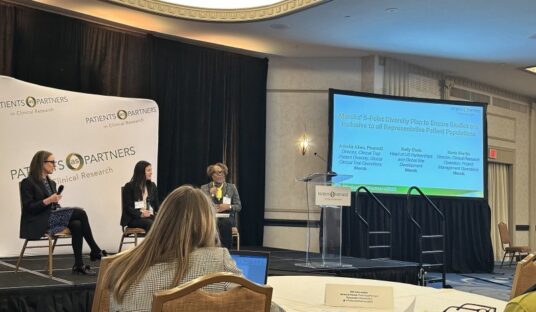
The Power of Patients as Partners 2023 Conference: Turning Insights into Action
Clinical Trial Experience
Diversity in Clinical Trials: Beyond Fantasy